
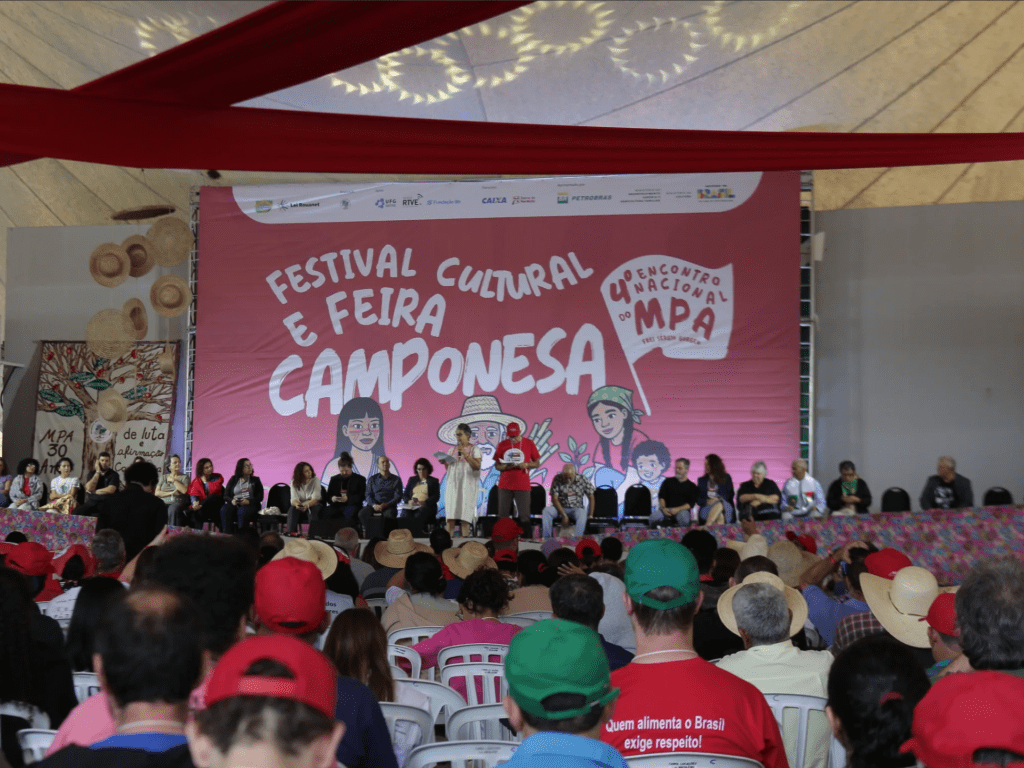
Between 11 and 14 May, more than 1,000 small farmers from 20 Brazilian states gathered in Brasília for the 4th National Meeting of the Movimento dos Pequenos Agricultores (MPA), or Small Farmers Movement in English. Bringing together farmers, activists, and allies from across Brazil, the meeting focused on agroecological food production, sustainable agriculture, public policies, territorial rights, and food sovereignty.
Hosted at the Athos Bulcão Community Center at the University of Brasília (UnB), the four-day event also featured an agroecological farmers’ market, a cultural festival, and celebrations marking 30 years of the Small Farmers Movement in Brazil.
Under the theme “MPA: 30 years of struggle and peasant empowerment, building food and national sovereignty”, beyond the MPA’s members, the 4th National Meeting gathered representatives of Brazilian Government and institutions, as well as members of other national and international movements.
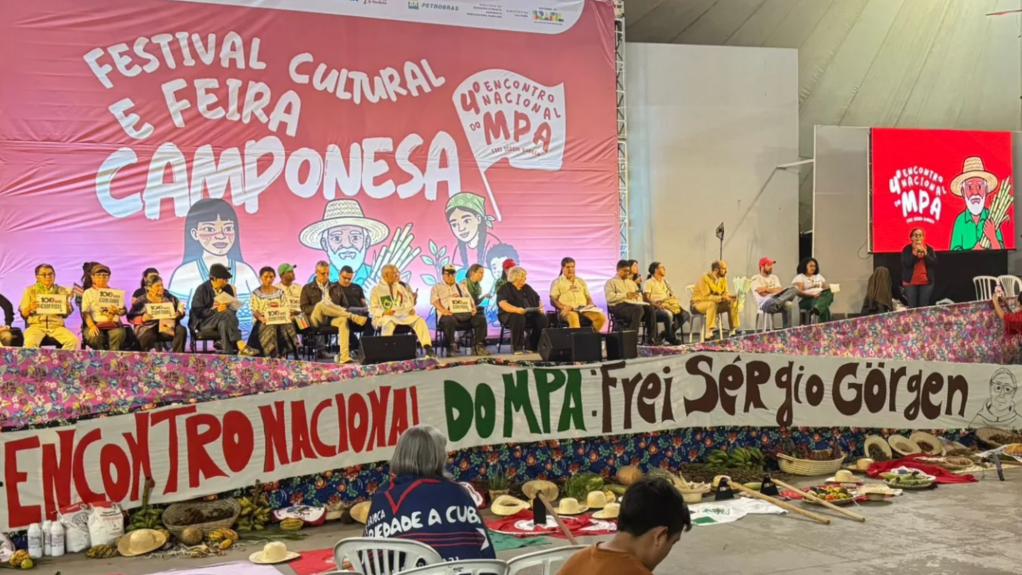
The gathering also included a celebration in memory of Frei Sergio Görgen, one of the most important figures for grassroots movements in the Global South, bringing together leaders from across Brazil.
Who are the Movimento dos Pequenos Agricultores (MPA)?
The MPA is a national, socialist, grassroots and autonomous countryside movement engaged in permanent struggle that was founded in Rio Grande do Sul in 1996. Its social base is organized in family groups within peasant communities that seeks to reclaim peasant identity and culture in its diversity. More than this, the MPA stands alongside other popular movements in rural and urban areas to build a popular project for Brazil based on sovereignty and the values of a just and fraternal society.
Currently, the MPA is organized in 20 Brazilian states across all regions of the country, and after 30 years of existence, it has a significant history of struggle and organization of the Brazilian peasantry. Believing that the process of transforming society also depends on international action and solidarity, the MPA is also part of Via Campesina International and the Latin American Confederation of Rural Organization (CLOC-LVC).
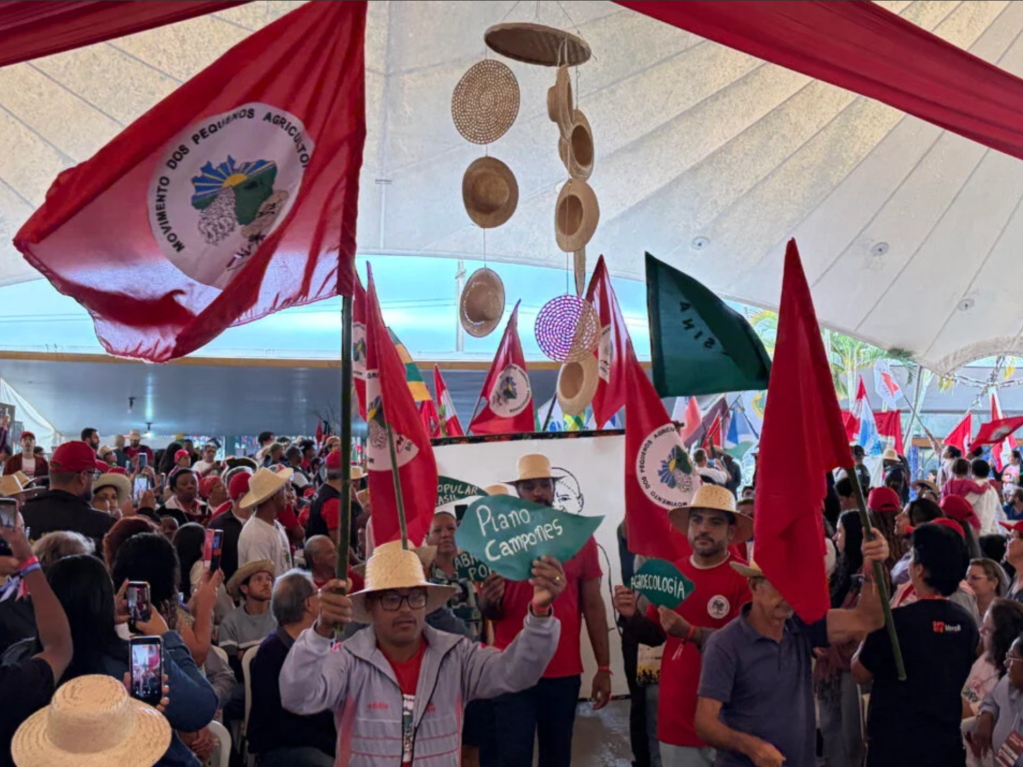
Popular Sovereignty is the key to change the world
Reinforcing the commitment to a grassroots initiative focused on food, territorial, and popular sovereignty, along the four days of 4th National Meeting, the small farmers took part in discussions and analysis about current political situation, popular culture and agroecological production. In all of these debates, the role of the people and collective organization was reaffirmed as the only way to change the reality and subvert the neoliberal logic imposed by the capitalist mode of society.
At the end of the 4th National Meeting, the MPA presented a policy document that identifies food sovereignty as a strategic pillar for addressing the climate crisis and the encroachment of large corporations on local territories. In it, the MPA reaffirms their commitment to building a development model based on environmental preservation, the autonomy of local communities, reaffirms their commitment to and the strengthening of peasant production.
Another key point in this document is the call to revive the Josué de Castro Mission, an initiative launched in 2025 in partnership with grassroots organizations, researchers, public officials, and social movements which aims to develop strategies to combat hunger, promote adequate nutrition, and, consequently, build food sovereignty.
Furthermore, in the document and throughout the Meeting, the MPA highlighted the need to strengthen the alliance among rural, urban, water, and forest communities to address social inequalities. It also emphasized the role of self-organization among women, black, and LGBTI+ people in overcoming the patriarchy and racism that underpin capitalist society.
Ways to Strengthen the Struggle in Defense of Food Sovereignty, Agroecology, and the Building of People Power
For the Movement, we are living through a period of crisis in capitalism, marked by intensifying global geopolitical conflicts and Brazil staying at the center of this dispute. Given this scenario, it is urgent to build a set of actions with Brazilian society to construct a national project capable of facing the country’s structural problems. To do this, it is necessary to build a broad social, political and popular movement capable of driving forward a People’s Project for Brazil.
On the other hand, from an international perspective, we must denounce the offensive by US imperialism against all peoples who wish to determine their own destiny. We must denounce the US imperialist model, which has long been perpetrating massacres to ensure the maintenance of its power, as it has done in Palestine, Cuba and Venezuela.
In considering how to respond to this series of challenges and contradictions, the MPA set out seven proposals in the policy statement presented at the end of the meeting, which will form the basis for its work in the coming period. In summary, these are:
- With a view to developing a strategic plan for the countryside and for Brazil, we must devise short-, medium- and long-term actions. Drawing on grassroots organisation, political education, agroecological food production, cooperation and peasant culture as tools for building popular power, these actions must link the concrete struggles of the present with a historical vision of social transformation.
- To strengthen the rural-urban alliance, recognising the peasantry as a political and social force which, in alliance and organisation with the working-class sectors of the cities, has the power to spearhead the major transformations the country needs and to build a new national project: the People’s Project for Brazil.
- Construction of the Josué de Castro Mission, aimed at improving access to healthy food for the general public. This should serve as a means of building social power to establish food sovereignty in local communities, whilst promoting the transformation of the current food system.
- To organise the peasant and grassroots communities, with a commitment to caring for peasant children and young people; to strengthen traditional and ancestral territories; and to prioritise the struggle against all forms of oppression based on identity, race and gender.
- To defend national sovereignty and internationalist solidarity, denouncing US imperialism and promoting solidarity with the peoples of the world and the defence of peace. Likewise, to denounce the genocide in Palestine, the blockade of Cuba, the aggression against Venezuela and any and all attacks on popular sovereignty.
- To re-elect Lula as President of the Republic as a prerequisite for safeguarding democracy and ensuring the potential for progress in grassroots organisation and the struggle for rights, sovereignty and social transformation in Brazil. Likewise, to elect a parliamentary group committed to the People’s Project for Brazil and to the uncompromising defence of the interests of national sovereignty and the Brazilian people.
- To strengthen territorial organising efforts in order to build the Peasants’ Strike as a tool for mobilisation and public pressure, with a view to expanding rights such as: credit for food production, housing, education, schools, agribusiness and decent living conditions for the Brazilian people.
Internacional Solidarity and Global Struggle
The event was attended by an international delegation comprising representatives of peasant movements from 17 countries across four continents: Latin America and the Caribbean, Africa, Europe, and Asia. During the 4th National Meeting, a counter-hegemonic protest titled “Night of Sovereignty and Solidarity of the Peoples” was held, organized by the Latin American Coordination of Rural Organizations (CLOC – Via Campesina), and attended by figures such as Aleida Guevara, a Cuban doctor and daughter of Ernesto Che Guevara.
In a context of geopolitical crisis, where the use of famine, economic sanctions, and international blockades is becoming increasingly common as mechanisms of war against peoples, international solidarity — which is one of the MPA’s founding values — emerges as an even more essential element of our daily struggle. For this reason, during the current political situation analysis that happened as a part of the counter-hegemonic protest, the MPA affirmed their commitment to the “Internationalist Decree,” a document signed by the present organizations that outlines 14 commitments in defense of food sovereignty, agroecology, and solidarity among peoples.
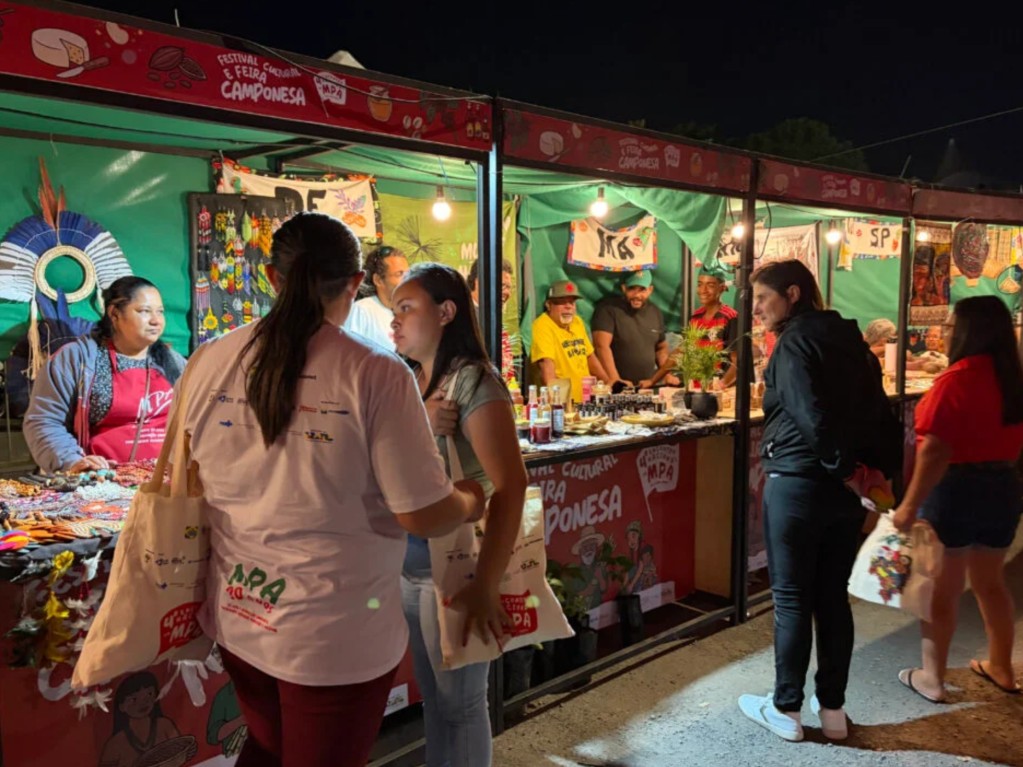
Agriecological Farmers’ Market and popular production
During the event, an Agriecological Farmers’ Market was also held, featuring around 50 stalls offering products from Brazil’s five regions: the North, Northeast, South, Southeast, and Midwest. Visitors to the event were able to browse and purchase products made by MPA members, including native piglets, sweets, beverages, fresh foods, and handicrafts.
In addition to the farmers market, the meals served throughout the event were provided by food donations from rural farming communities. According to the movement, approximately 23,000 meals were served, prepared from 32 tons of food grown by peasant families. In addition, approximately 1,000 meal boxes were distributed to homeless people, communities of Afro-Brazilian religions, and people from the LGBTI+ community in the Federal District, the Brazilian city where the gathering took place.
Cultural Festival: celebrating people’s memory and resilience
For the MPA, popular culture is integral to the construction of the rural population’s identity and resistance, forming the backbone of the peasant struggle. As such, the struggle for sovereignty and social rights is inseparable from the preservation of the traditions and festivities of rural communities. Thus, during the 4th National Meeting, a Cultural Festival stands out as a moment of celebration and resistance.
Featuring artists whose work centres on Brazilian popular music and the struggles of rural communities, the Festival included performers such as Pereira da Viola, Zé Pinto, Antônio Gringo, Pedro Munhoz and Bruna Ave Cantadeira, as well as the groups Canto do Acauã and Samba das Pretas. In addition to the concerts and performances, the Festival was an opportunity to pay tribute to the legacy of Frei Sérgio Görgen, one of the leading figures of the Brazilian peasantry, who died on February 3rd this year at the age of 70.
Photos courtesy of Movimento dos Pequenos Agricultores
Emilly Firmino
Emilly Firmino is an activist in the Popular Brazil Movement, a journalist, a PhD student in Geography at the University of Brasilia (UnB) and a member of the Brazilian Research Network on Struggles for Spaces and Territories (REDE DATALUTA) and the Group for the Study of Collective Actions, Conflict and Territories (GEACT).
José Sobreiro Filho
José Sobreiro Filho is a professor in the Department of Geography at the Institute of Human Sciences (ICH) at the University of Brasilia (UnB), Brazil; deputy coordinator of the Brazilian Research Network on Struggles for Spaces and Territories (Rede DATALUTA) and coordinator of the Group for the Study of Collective Actions, Conflicts and Territories (GEACT).
Want more content like this? Subscribe to The Foodscapes Collective to be the first to know about articles like this and more.



 The Foodscapes Collective
Leave a comment