

Learning what common weeds tell you about your soil can help you identify problems like compaction, poor drainage, and disturbance before they affect your crops.
In Part 1 (What Your Weeds Are Trying to Tell You), we introduced the idea that weeds aren’t random—they’re ecological indicators responding to the conditions around them. Instead of asking, “How do I kill this weed?” we began asking, “Why is it growing here?”
In Part 2 (When Weeds Are Actually a Sign of Healthy Soil), we explored how species like pigweed, lamb’s quarters, and purslane often signal fertile, exposed soils, reminding us that some weeds are responding to conditions many crops actually prefer.
Now it’s time to dig deeper. Think of this article as a mini field guide to three common indicator weeds you may encounter across a wide range of growing systems. We’ll explore goosegrass, nutsedge, and Spanish needle, what research suggests they are responding to, and what their presence can tell you about your soil.
Remember: it’s not about memorizing plants. It’s about starting to ask yourself a different question when you see one: “Why is it growing here?”
These three weeds offer valuable clues about soil compaction, drainage, and disturbance, but they’re only part of the story. Other indicator plants—such as clovers, tick trefoils, and lespedezas—often signal low-fertility soils, a topic we’ll explore in a future article in this series.
Like always, weeds tell you about the current moment, and the soil tells you what that moment is built on top of. When you read both together, that is when the fun of diagnosis happens1.
Goosegrass (Eleusine indica)

Identification
Most people who know Goosegrass know it by its flattened blades with silvery bases that hug the ground and leave behind stringy hairs when pulled. Even though Goosegrass is a summer annual, once it puts down its fibrous roots, pulling by hand is useless.
Where It Grows
Eleusine indica is found throughout the tropics and subtropics, including Florida, the Caribbean, Africa, Asia, and the Pacific. Across its range, one pattern remains remarkably consistent: it thrives wherever soils experience repeated disturbance and heavy traffic.
You’ll commonly find it growing along sidewalks, greenhouse entrances, machinery rows, tractor turn areas, compacted pathways, and worn bed edges. In cooler climates, annual bluegrass or broadleaf plantain often occupy a similar ecological niche.
What It Is Responding To
Of the three plants discussed here, goosegrass is perhaps the clearest indicator of soil compaction. The University of Florida even lists it as a compaction indicator species2 3. When goosegrass repeatedly appears in the same location, it often signals that soil has become dense enough to restrict normal root growth and water movement.
Why It Succeeds There
Compacted soils contain fewer air spaces, limiting oxygen availability, slowing water infiltration, and preventing crop roots from penetrating deeply into the soil profile. Goosegrass has evolved to tolerate exactly these conditions. Its roots can tolerate low oxygen levels and limited water movement, which most crops consider limiting factors.
The weed isn’t creating compaction—it is taking advantage of it.
What It May Be Telling You
- Soil has become compacted from repeated foot or machinery traffic.
- Water infiltration is slower than it should be.
- The crop roots may be stressed from the inability to penetrate the soil profile.
What You Can Do
- Redirect foot traffic and reinforce worn pathways with mulch.
- Avoid working or tilling soils while they are wet.
- Plant deep-rooted cover crops such as sorghum-sudangrass, tillage radish (daikon), or sunn hemp to naturally loosen compacted soil.
Key Takeaway
If you simply remove goosegrass, it will likely return. Address the cause of compaction, and eventually the indicator disappears with it.
Nutsedge (Cyperus esculentus and Cyperus rotundus)

Identification
Nutsedge looks like grass and acts like grass, but nutsedge is not grass. It belongs to the sedge family (Cyperaceae). A simple way to tell the difference is by feeling the stem. As the old saying goes, “Sedges have edges.” Its triangular stem distinguishes it from true grasses.
The two most common agricultural species are yellow nutsedge (Cyperus esculentus) and purple nutsedge (Cyperus rotundus). Both are perennial plants that spread through underground tubers rather than seed alone.
Where It Grows
Yellow nutsedge occurs throughout warm and temperate regions worldwide, while purple nutsedge is considered one of the world’s most troublesome agricultural weeds and is found on nearly every continent4.
While they initially appear in wet conditions, nutsedge can survive in normal to dry conditions once established. That’s the key. While they send up greens where moisture levels are high, or soils don’t drain well, nutsedge will opportunistically spread to adjacent areas that aren’t terribly wet.
What It Is Responding To
Nutsedge most often points toward drainage problems. Low spots, over-irrigated areas, poorly drained soils, and places where water remains near the surface all create favorable conditions for establishment.
Research also shows that both yellow and purple nutsedge respond strongly to nitrogen fertilization, meaning dense populations can indicate fertile soils in addition to excessive moisture5.
One patch of nutsedge may therefore communicate two messages at once: the soil is staying wetter than it should, and fertility levels—particularly nitrogen—are high. Both of those pieces of information can help us better determine our management response. Improving drainage may not fix the problem if nitrogen is applied to an area.
Why It Succeeds There
Once established, nutsedge becomes difficult to eliminate because of its underground tuber system. Nutsedge tubers can survive for years in the ground just waiting for the perfect conditions to send up a shoot or two.
One plant of yellow nutsedge can create thousands of shoots and tubers in just one growing season. Purple nutsedge forms tubers in clusters along a single underground stem that travels horizontally through the soil.
Pulling the plant out by the stem doesn’t eliminate the tubers. Unless the conditions that favored establishment are corrected, the underground tubers remain ready to regenerate.
What It May Be Telling You
- Poor drainage or low-lying areas.
- Water is lingering near the soil surface.
- Irrigation may be excessive.
- Nitrogen levels are relatively high.
- The infestation has likely been developing longer than it appears.
What You Can Do
- Reassess irrigation timing and frequency.
- Improve drainage where possible using grading, swales, drainage pipe, furrows, or ditches.
- During scouting, pay close attention to where nutsedge first emerges each season.
- Intervene early before underground tubers multiply and become much more difficult to manage.
Key Takeaway
Learn where nutsedge first appears, don’t sweat the current population size. That is usually where the underlying drainage problem begins.
Spanish Needle (Bidens alba)
Identification
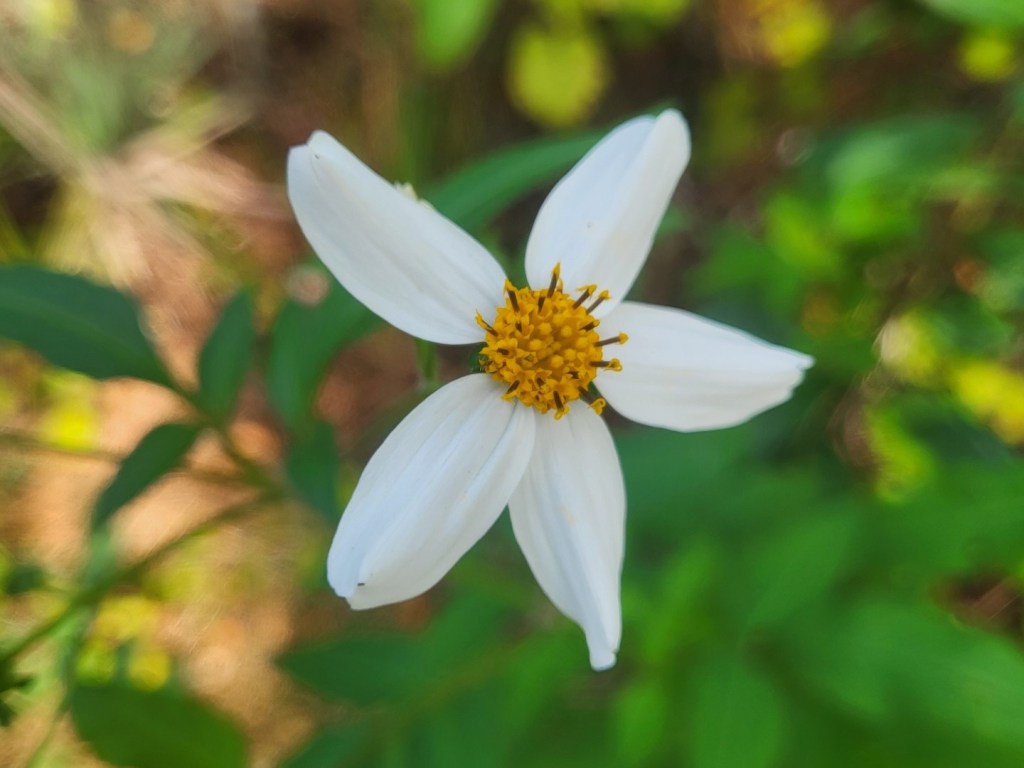
Spanish needle is one of the defining plants of Florida’s subtropics. It produces white petals surrounding a yellow center and has barbed seeds that attach to any unsuspecting body that passes by. You know it when you see it.
Although viewed as a weed, spanish needle is the third most important honeybee nectar plant in Florida, behind citrus and saw palmetto6.
Where It Grows
Bidens alba is commonly found along roadsides, field edges, disturbed garden beds, food forests, and other open areas receiving full sun. It thrives wherever the soil surface is repeatedly disturbed and vegetation leaves bare patches exposed.
What It Is Responding To
Spanish needle lacks strong preferences, meaning it will grow just about anywhere. According to the University of Florida, it grows in rich soil to poor soil, is present in disturbed sites with people or animal traffic, and prefers somewhat dry conditions and full sun exposure7. Repeated cultivation, foot traffic, canopy openings, animal movement, and exposed soil create opportunities for this species to establish.
This highly successful plant isn’t looking for your fertilization schedule. Instead, Bidens is telling you something is repeatedly visiting and turning over this ground, and there’s enough of a gap in the canopy above for this bad boy to move right in.
Why It Succeeds There
In ecological terms, Bidens is what’s called a pioneer species. It is among the first plants to colonize disturbed ground, rapidly covering exposed soil while beginning the early stages of ecological succession.
Rather than asking why Bidens is present, it is often more useful to ask why the ground remains open enough for it to establish in the first place.
You’ll often find pigweed growing nearby. Together they tell a more complete story: pigweed points toward fertility, while Bidens signals disturbance. Reading both plants together provides a clearer picture of what is happening in the field.
What It May Be Telling You
- Bare soil is remaining exposed for too long.
- Vegetative cover is incomplete.
- Regular disturbance is preventing succession.
- Groundcover recovery has been interrupted.
What You Can Do
- Identify what is repeatedly creating bare ground.
- Maintain living ground covers where practical.
- Apply mulch between beds.
- Use cover crops to quickly occupy open space before pioneer weeds do.
Key Takeaway
The answer to Bidens is not simply removal—it’s restoring continuous ground cover. Close the gap, and the invitation for Spanish needle disappears.
Conclusion
The more time you spend on the same piece of land, the more these patterns repeat. Goosegrass returns where the soil stays tight. Nutsedge follows the water and the fertility. Bidens settle wherever the earth is left open or disturbed.
In actuality, none of these plants is trying to frustrate you. They are following their evolutionary paths by growing where conditions suit them. The real lesson is not memorizing which weed means what — it is learning to slow down and ask why a particular plant chose that place and what does that mean? How does that inform my approach to cultivation practices? The core idea is that nature is communicating, each field has its own way of speaking, and “weeds” represent some of the very first things it says.
- Samuel, N., & Marble, C. (2023). Weeds as indicators of soil conditions in lawns and landscapes(ENH1370/EP634). University of Florida IFAS Extension. https://doi.org/10.32473/edis-EP634-2022 ↩︎
- Petelewicz, P., & MacDonald, G. E. (2025). Identification, biology, and management of Goosegrass [Eleusine indica (L.) Gaertn.] in Florida turfgrasses (SS-AGR-488/AG483). University of Florida IFAS Extension. https://doi.org/10.32473/edis-ag483-2025 ↩︎
- Arrieta, C., Busey, P., & Daroub, S. H. (2009). Goosegrass and bermudagrass competition under compaction. Agronomy Journal, 101(1), 11–16. https://doi.org/10.2134/agronj2007.0282 ↩︎
- Saha, D., Marble, S. C., Boyd, N., & Steed, S. (2019). Biology and management of yellow (Cyperus esculentus) and purple nutsedge (C. rotundus) in ornamental crop production and landscapes (ENH1305/EP569). University of Florida IFAS Extension. https://doi.org/10.32473/edis-ep569-2019 ↩︎
- Morales-Payan, J. P., Stall, W. M., Shilling, D. G., Dusky, J. A., & Bewick, T. A. (1997). Influence of nitrogen on the interference of purple and yellow nutsedge with tomato. HortScience, 32(3), 431. https://doi.org/10.21273/HORTSCI.32.3.431C ↩︎
- Florida Wildflower Foundation. (2024). Beggarticks (Bidens alba). https://www.flawildflowers.org/flower-friday-bidens-alba/ ↩︎
- Khamare, Y., Marble, C., Steed, S., & Boyd, N. (2019). Biology and management of Spanish needles (Bidens spp.) in ornamental crop production (ENH1308/EP572). University of Florida IFAS Extension. https://doi.org/10.32473/edis-ep572-2019 ↩︎
This article is adapted from a longer original essay by Andrew Gerren, published on Sacred Herbs and Botanicals. You can read the full version here.
This piece is part of the Reading the Landscape mini-series by Foodscapes Collective, which explores how plants, soil, and ecological patterns reveal information about land health. Explore the full series here: (coming soon)
For a practical field reference of indicator plants and what they may suggest in tropical, subtropical, and temperate systems, visit: Weed Indicator Field Guide
Photo courtesy of Andrew Gerren

Andrew Gerren
Andrew Gerren is a farmer, ethnobotanist, and sustainable agriculture consultant with 17+ years of tropical farming experience and over a decade in plant medicine. Trained at the University of Hawai‘i at Mānoa, he specializes in soil health and regenerative systems tailored to local microclimates. He is a Returned Peace Corps Volunteer where he worked with smallholder farmers in Jamaica. He previously managed Newfield Farm in Florida and currently manages a 10+ acre plot for a private residential community. Andrew now runs Sacred Herbs & Botanicals and Incredible Foodscapes, advancing resilient, community-based food systems.

Joel Matheson
Joel Matheson is co-founder of The Foodscapes Collective and is passionate about sustainable agriculture, food security, and climate resilience. He holds an MA in Global Studies and a BA in Environmental Studies. He was a Peace Corps volunteer in Jamaica and Nepal.
Want more content like this? Subscribe to The Foodscapes Collective to be the first to know about articles like this and more.





 The Foodscapes Collective
Leave a comment