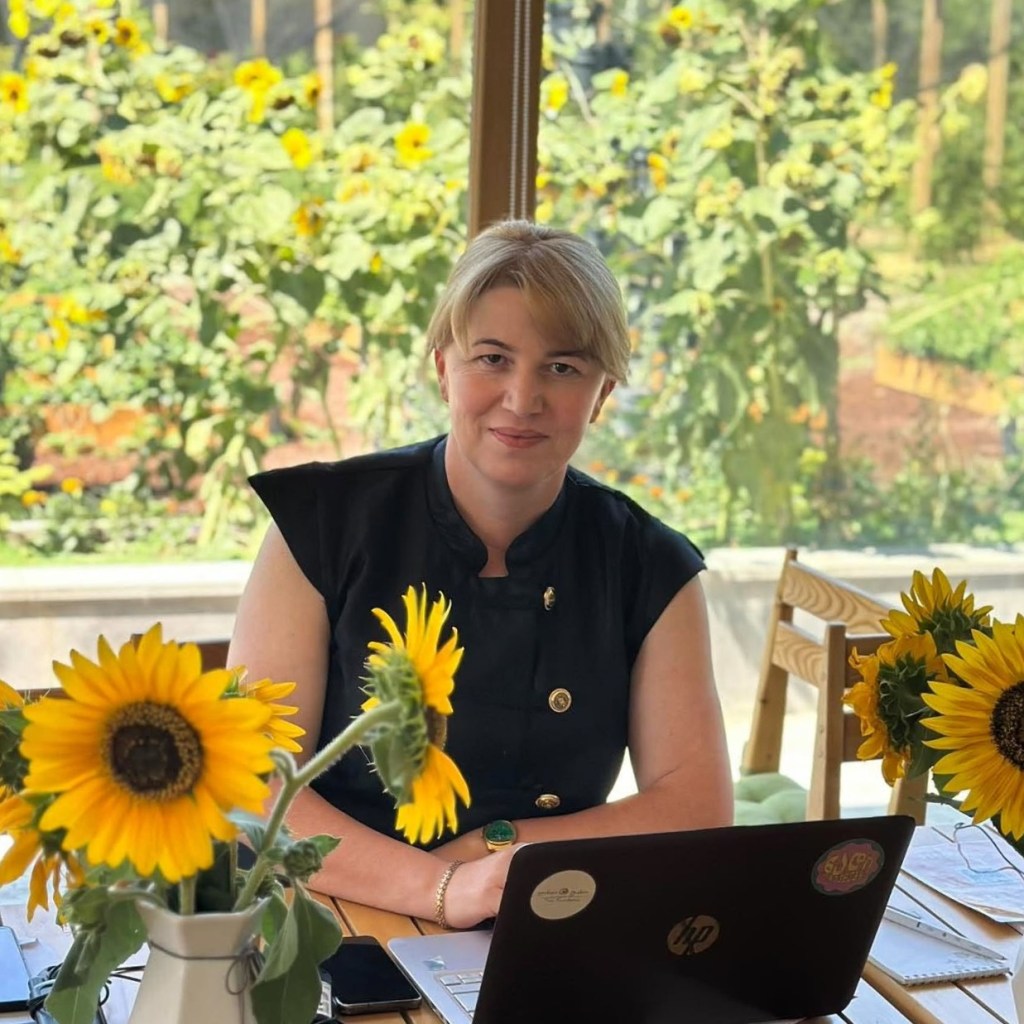
Name: Naira Paqsadze
Location: Maradisi in Georgia’s Kvemo Kartli region
Type of Farming: Vegetable farmer (broccoli, lettuce, cucumbers, asparagus, and kale)
Years Farming: 7 Years as a business, but farming since childhood
This article was translated from Georgian into English, for Georgian language, click here.
Naira is a farmer and agronomist from the village of Maradisi in Georgia’s Kvemo Kartli region. She has loved working the soil since childhood, but for years she grew vegetables only for her own family. That changed in 2019, when a ten-day business training led her to ask herself what she loved most, and the answer was agriculture. She won her first grant, from the Taso Foundation, to buy seed material, and has been building her farm ever since.
Her village has its own story of starting over. After a landslide in Adjara, a mountainous autonomous republic in Western Georgia, her community was resettled to Maradisi, where families arrived to bare land and spent decades building their own homes. Only once housing was secured could they turn to roads, water, electricity, and waste collection, and then to business. Naira describes it through Maslow’s pyramid: “Until the first need is met, you can’t think about a public square.” Today, she says, there are around seventy funded projects in the village, and all of them are working.
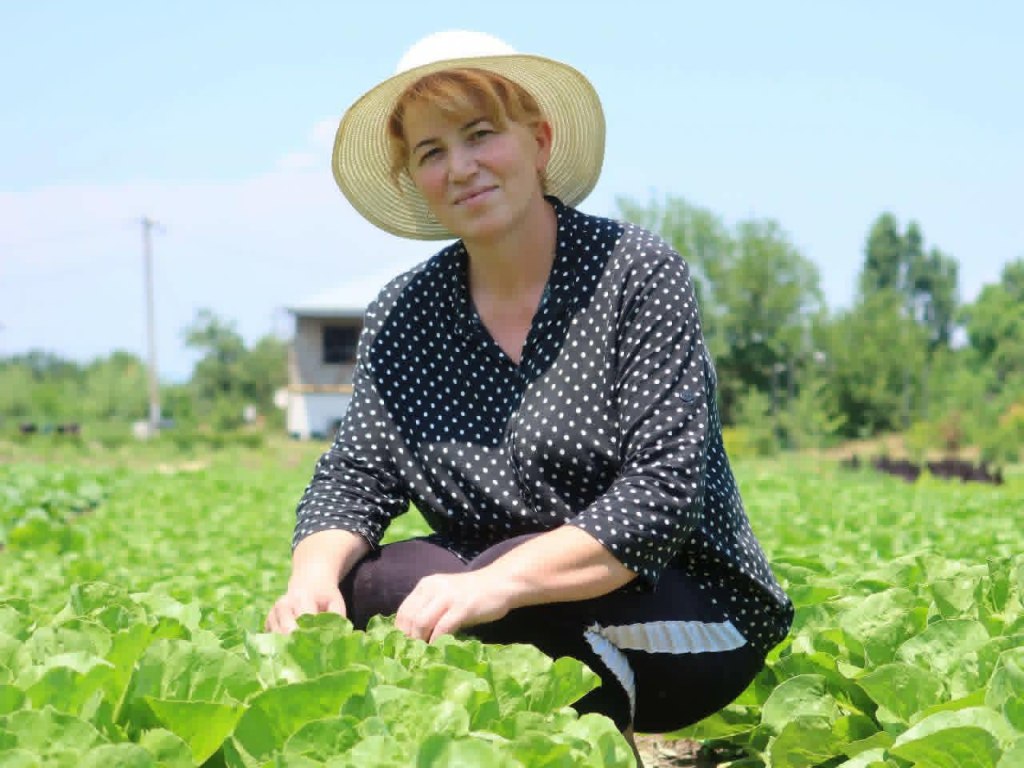
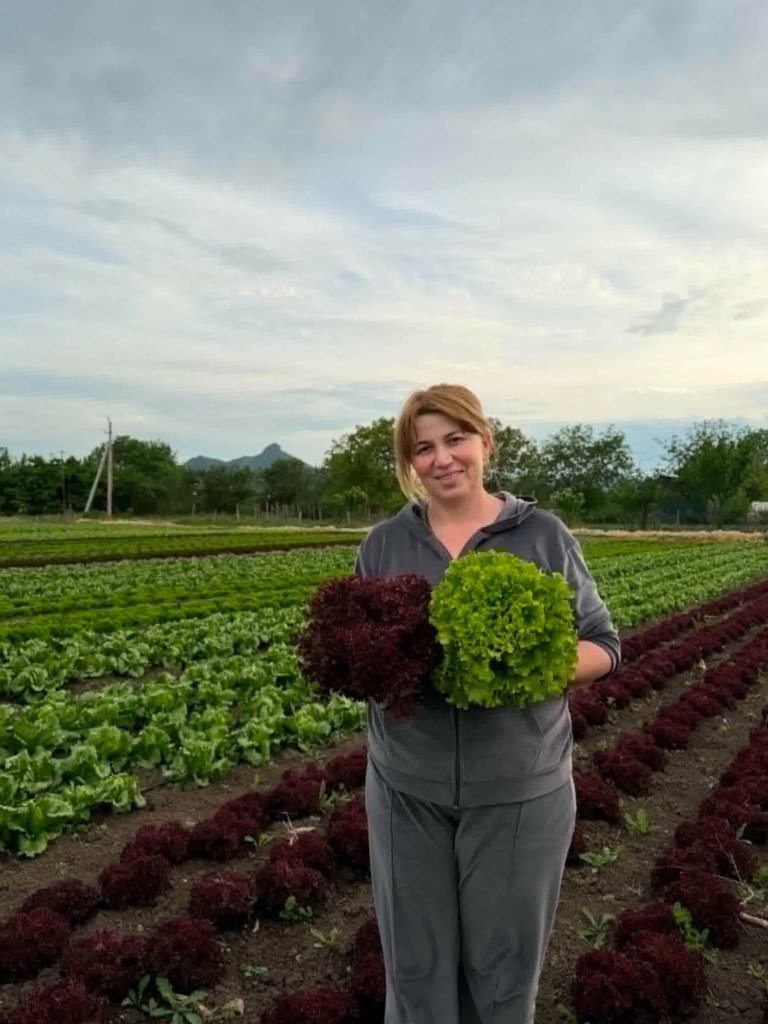
Naira grows broccoli, lettuce, cucumbers, asparagus, and kale, and she was the first in Maradisi to plant several of them. Broccoli, now grown by the ton across the village, began in her greenhouse. She teaches farmers and local college students to grow healthy produce with less pesticide and fertilizer, and her work has met real challenges: this year an unexpected snowfall destroyed three of her greenhouses, and imported produce competes hard with local crops. During COVID, when Marneuli went into lockdown, she gave away five tons of lettuce to her neighbors for free.
She is also a founder of “Green Maradisi,” a women’s agricultural cooperative of ten members that grows hundreds of thousands of seedlings each season for farmers across Georgia. Naira believes it is the only functioning women’s cooperative in Kvemo Kartli. The women divide the work by strength, whether watering, sowing, planning, sales, or client relations, and now hope to build a training center so that what they have learned can reach farmers well beyond their village.
In recognition of the International Year of the Woman Farmer, The Foodscapes Collective is highlighting women farmers whose work sustains families, communities, and food systems. This series shares the voices and experiences of women farmers through short conversations about their journeys, and the meaning of growing food.
In this profile, Naira reflects on how a love of the land became a business, a cooperative, and a model for other women in her community.
What first inspired you to become a farmer?
Naira: I’ve loved agriculture since childhood. I’ve been involved in farming, and I love the greenery. Working with the soil gives me great pleasure, and it’s a kind of release for me. But I only grew vegetables for our home, for the family. I never thought of starting a business. Then in 2019, when UN Women came to our village, they funded us through trainings from the Ministry of Finance. This was our first time participating in these trainings, and that was my source of inspiration, because the trainer explained the idea to us very well: turn what you love into a business. We had a ten-day training. After every session, when I was left alone, I would think about what my favorite thing was. It was agriculture, and I knew I had to go in the direction of agriculture. So I turned what I love into a business. I wrote my first grant, and I won it from the Taso Foundation. That project was also about agriculture. It was for seed material, my first grant, and since then I’ve turned what I love into a business.
Matt: Wow, that’s great. The Taso Foundation came to Maradisi, right? Could you tell us about Maradisi, what kind of village it is, how you got here?
Naira: In the 1990s there was a landslide in Adjara, and as a result, our village was resettled to Maradisi. But at that time we had no houses. We moved in, one room each, one railway car each, and houses were supposed to be built for us, but they weren’t. From the 1990s until 2019, every resident was trying to build a house. Up until 2019 we were building the village, and nobody was thinking about business, or about social spaces, a school, a kindergarten. Everyone’s only goal was to build a house. We had lived without homes for so long, and we wanted a home so badly. Then in 2019, when the Taso Foundation came to our village with UN support, and then through the trainings, we started to think about what we needed. We needed public squares, for instance, a great many. Basically, the garbage truck didn’t even come into the village. We needed to start businesses, but nobody was thinking about development in any way. After 2019, everyone understood that we needed to start businesses, that we women had to step forward and do something together. Everyone had been absorbed in their own affairs, and everyone had the same goal, to build houses. Since then, since 2019, we’ve been involved in these projects. That’s seven years now. At the moment there are up to seventy funded projects in the village, and all of them are working.
Matt: Wow.
Naira: There’s Maslow’s pyramid. Until the first need is met, you can’t think about a public square. And our first need was a home. Once we had built the houses, then we realized we could advocate. For example, we could go to the municipality, go to the Clean Marneuli office about waste collection, get trash bins placed in the village and a garbage truck to come in. We needed a road, water, electricity. We had none of that. I don’t even know how we lived, because the electricity we had was very weak, brought in through such cables that it was basically out of the question to run refrigerators or milking machines, because we didn’t have that kind of power. After that we understood that we could advocate for all of this, and we women began to do it actively with the help of various projects. Now we have electricity, we have water, we have a road, the garbage truck comes in. We’ve started a human life, as it were, and now the women living in the village have businesses too.
Matt: That’s great. And if I understood correctly, when you arrived in Maradisi, was there only land?
Naira: There was no house and nothing else, only land, and we started living on that land.
Who taught you how to farm? Where did you learn?
Naira: As I said, I loved agriculture from childhood. Anything related to agriculture always interested me, and I looked for information everywhere. But when I gave my activity the form of a business, farming proper, many organizations supported me. There was CENN, the Taso Foundation, and FAO also funded me. They funded me with many trainings and seminars. I also went to Germany on a program with funding from the Skills Agency. In short, every organization made its contribution to my becoming a farmer and agronomist. I’ve completed a great many trainings and seminars, and that’s exactly why I want to justify this investment made in me and teach others what I’ve learned.
What does a typical day on the farm look like?
Naira: I don’t know how typical my days are. Each day is different. My day starts at half past seven. I get up at seven thirty and go to the greenhouses, and my team comes with me. We plan what we’re going to do. First we begin by picking cucumbers, because later it gets hot in the greenhouse and the cucumbers can’t be picked. So I’m busy almost the whole day. We get everything done by twelve: we pick the cucumbers, and whatever crop needs picking or planting, we get all of it done in the greenhouses. After twelve, my team and I move on to the open ground. In the open ground, we also always have some work, either picking, planting, or hoeing. Then I go to the college, where I have three or four practical lectures at least. I go to the college if we have work to do there, and if not, the college students come to me and we continue working, practical work together with the college students. We do things together with the students: we plant, we sow, we weed. We do all this step by step. The college students learn as they help me.
Matt: How many years have the students been coming to you?
Naira: Three years. For three years now we’ve had a memorandum signed with the college.
Matt: How did this memorandum begin?
Naira: The college director and the head of academic affairs came to me for a first meeting. They were interested in a woman entrepreneur doing vegetable growing in Marneuli, and they themselves asked me to collaborate with them. For me it was exciting because a great many resources had really been invested in my work. I had learned a lot, completed many trainings and seminars, and I didn’t want to use that only for myself. I wanted to share my knowledge. Also, there are a great many farmers in Marneuli Municipality, but, unfortunately, very few grow healthy produce. So I wanted to teach students that you don’t need to put fifty kilograms of pesticide into one greenhouse. With less pesticide and less fertilizer you will still get a wonderful harvest. If we observe the waiting days after pesticide use, nothing bad will happen, and on the contrary, it’s very good. I wanted to teach all of this to other farmers and to students, and over these three years it’s gone very well.
What challenges do you face as a woman farmer?
Naira: There really are a great many challenges in agriculture. Let’s start with the fact that climate change is a global matter, not only ours. We also have many problems caused by climate change. For example, this year we didn’t expect snow at all in Marneuli, and the snow ruined three of my greenhouses. There are also problems with sales on the markets. We struggle to sell all our produce on the Georgian market due to heavy competition with imported produce. And then there’s growing the crop itself, which is also a climate problem. For example, the way we grew crops five years ago no longer works. The climate has changed, and we have to change gradually too, and we’re adapting differently. Every year we learn to adapt to the market and to practice climate-resilient agriculture.
What does growing food mean to you? Is there a crop/product that feels especially meaningful?
Naira: It gives me great pleasure that no matter what happens, we always have food. For example, I’ll recall one day during COVID, when Marneuli was locked down. At that time I had five tons of lettuce in the greenhouse, and I posted a notice. Many newspapers also wrote that people could come and take the lettuce, and I think I supplied half of Marneuli. Whoever could, everyone came and took it, free of charge. I also asked the TV stations to come and cover it, that people could take it for free. It was a kind of joy for me. I’m also glad that my produce is healthy, that this healthy produce goes onto the Georgian market, and that someone really knows it’s healthy and buys it, and that I have my customers. A special crop is broccoli, because in our village, Maradisi, I was the first to sow broccoli, and now it’s very popular. The whole village grows it by the ton, and in Georgia too it has become very popular, and it’s healthy.
Matt: Was broccoli popular before?
Naira: Before, I don’t know. In our village it wasn’t. Nobody sowed it and nobody grew it. After I began growing it, everyone became interested and now they grow it, too.
Matt: What do you grow the most of now?
Naira: We still grow the most broccoli. We grow lettuce leaves, cucumbers, and we’re gradually adding new crops. In our village, I was also the first to plant asparagus, and this year several families expressed a wish to make small asparagus plots themselves. I already have quite large asparagus gardens. I was also the first to sow kale in this village.
What advice would you give to a young woman who wanted to farm?
Naira: I would advise that they absolutely must start doing the work. Farming is a very good and pleasant process. I also think every woman should have her own income. For housewives who live in villages, farming is very good. For any woman who thinks she can’t do anything, farming is tailor-made, because they live in the village, everybody has land, everybody has plots, everybody can sow, and every woman can grow healthy produce, become a farmer, have her own income, and not be dependent on anyone.
Matt: In Georgia, culturally, how is it? For example, in America people sometimes think farming is a man’s job, but I don’t know whether that stereotype exists in Georgia too.
Naira: No, I don’t think so, because I think that on farms a woman’s mind is sharper and she thinks better about what to sow and how to grow it. In our own family, every time we sowed according to my husband’s opinion, we weren’t lucky. So in the end we understood, we arranged things so that my husband was good at sales, and planning the farm, growing, and tending were my job.
It works out better that way. I think Georgian women are very smart and very hardworking.Of course, I don’t think a woman should work all day with a hoe. A woman should plan, use her mind, and hire helpers who will do the labor.
Matt: Among the young people you work with, are there more women or men?
Naira: It’s a mixed group, there are both women and men. I’m happy that at this stage there are farmers who have plots of land in Marneuli and grow vegetables, and I’m very glad that we teach correct growing of produce, and that they corrected things on their own farms, such as fertilizer application, care, and growing. Now, for example, before I knew about growing all this, I remember we applied large amounts of nitrogen and thought we’d get a good harvest, and that’s not how it is. With small amounts of fertilizer we can grow a good harvest.
Please tell us about Maradisi’s cooperative.
Naira: In the village of Maradisi we created an agricultural cooperative, “Green Maradisi.” We women founded it. I believe it’s the only women’s cooperative in Kvemo Kartli that is functioning right now. We have a greenhouse and we grow seedlings. In season we grow hundreds of thousands of seedlings for all of Georgia, for various regions. In short, the cooperative, the women’s cooperative, is working very well at this stage, and we want to build a training center on the basis of the cooperative. If a donor appears and helps us build the training center, that would be very good. With our physical labor we spare no effort to grow many and varied crops and good seedlings, and to make good demonstration plots for farmers to see. We also hold field days, and interested people come and we teach them to grow a healthy harvest. We want all of this to be accessible to everyone, not just for one small village or a few farmers. If we’re given the opportunity, that will be very good.
Matt: How did the idea of the cooperative begin?
Naira: Our village, in general, from the day it started, from the day the village was created, the whole village works as one team. We do teamwork very well. The idea came from me too: since we were good at working as a group, let’s do a common project. That common project was the idea of the cooperative, and then the organization CENN came in and funded the cooperative. We built a small greenhouse, and for three or four years now we’ve been working as one team, and we have very good results and very good harvests. And now we want to share what we’ve learned, the trainings we’ve completed, and the crops we know how to grow with other farmers, to host other groups, and to build a training center.
Matt: Very good. Teamwork is very important, but it can be hard. Why does teamwork work well in Maradisi?
Naira: I would say it’s because we’ve distributed the tasks very well in our cooperative. The work is divided among ten people, and we know very well who can do what, and we distributed the tasks accordingly: who is good at watering, who at sales, who at sowing, who at planning, who at dealing with clients. We have all of this distributed well, and that’s why we work well.
Matt: Very good. And I know that in this team you are one of the leaders, and I’m interested in your thoughts and ideas about leadership. What is a good leader, who are they, what do they do?
Naira: I wouldn’t single out one leader. Still, it was originally my idea to make a cooperative, and it was my great wish, and the whole team really went along with it. I had the support of the whole team, and I still have very good support, I’ll say that. They never doubt me and they never let me down. On the contrary, they always stand by me. Now too, the idea of making a training center is also mine, and when I first voiced it, I was a bit afraid of what they would say to me. But every woman told me, “We’re beside you, and whatever you decide, we’ll follow you in everything.”
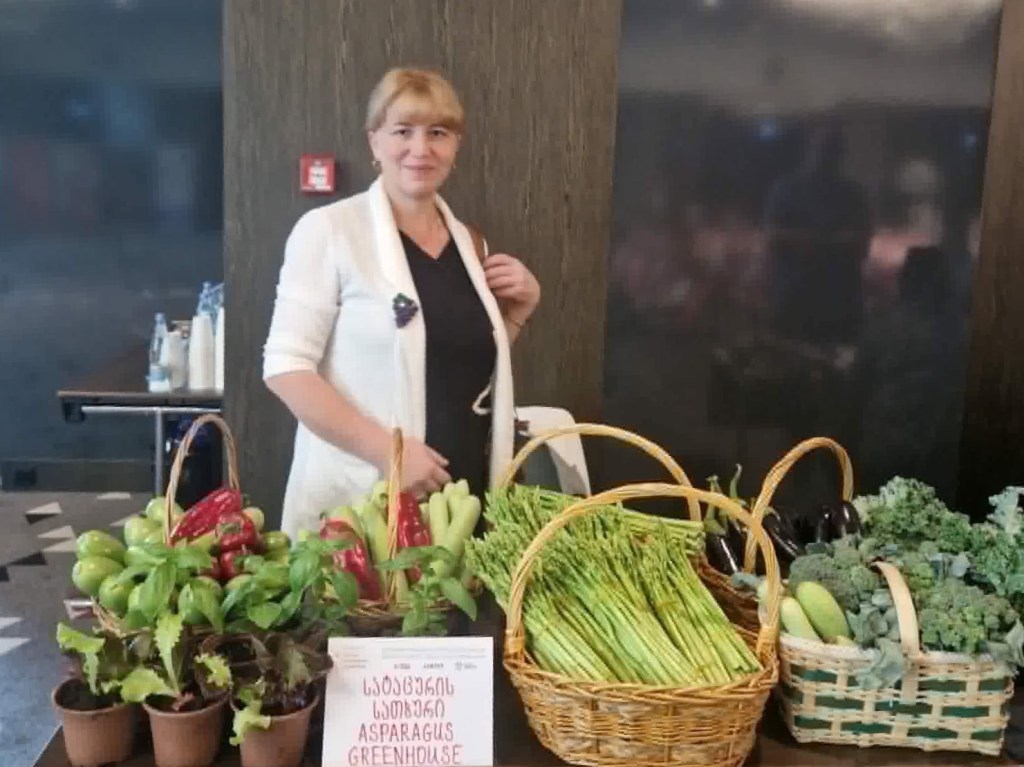
Photos courtesy of Naira and Matt.
Matt Schultz
Matt Schultz is a Community Economic Development Peace Corps Volunteer in Georgia. Matt is based in Marneuli, where he works with Radio Marneuli and the Marneuli Center for Civic Engagement. Originally from Arlington Heights, Illinois, he holds a BA in political science, French, and Spanish from the University of Illinois Urbana-Champaign and is a proud alumnus of the Fulbright and Critical Language Scholarship programs.
Want more content like this? Subscribe to The Foodscapes Collective to be the first to know about articles like this and more.




Leave a Reply