
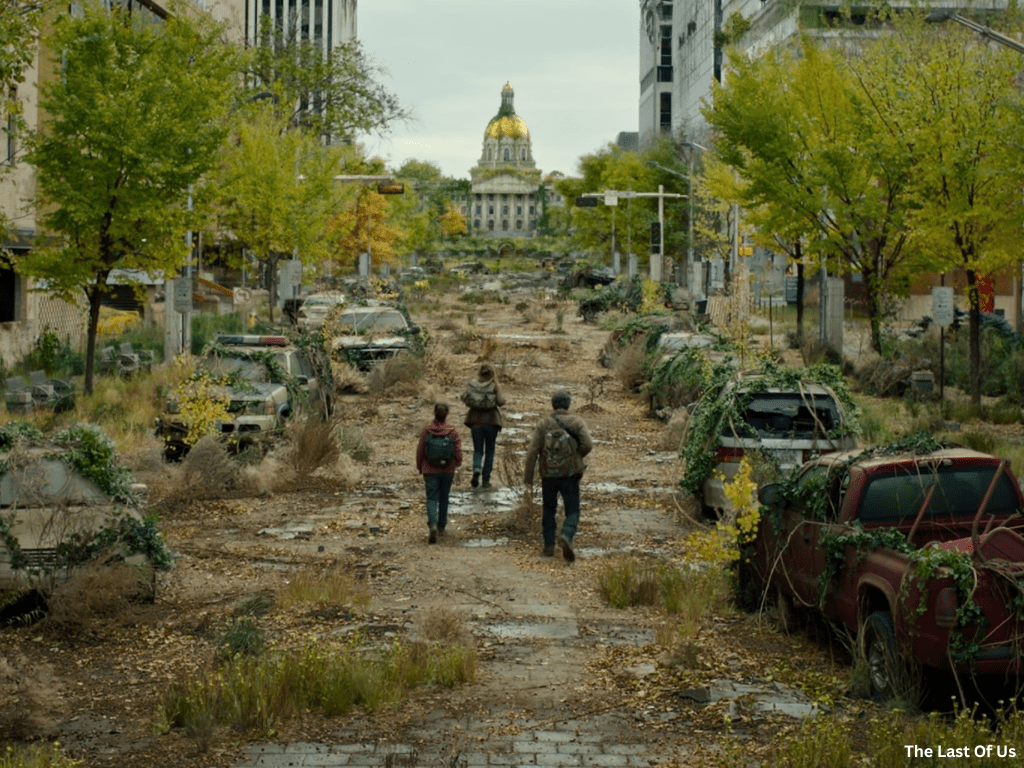
Food in post-apocalyptic films serves as a powerful storytelling device, revealing themes of power, class inequality, survival, and community in imagined futures.
These films love to show us the end of the world: empty cities, poisoned landscapes, and wandering survivors scraping by after nuclear fallout, zombies, climate collapse, you name it. But while we’re watching the characters fight to survive, there’s one question that we rarely stop to ask – what are they actually eating?
Food shows up again and again in these films, quietly carrying enormous meaning, and yet food is never just food. What characters eat, how they eat, and who gets to eat tells us more about the worlds being created than dialogue ever could.
“The social setup around food — the meal, the table, and who gets to sit there — turns out to be incredibly important,” says Professor Chris Broodryk, Associate Professor at the University of Pretoria, tells The Foodscapes Collective.
Power, control, fear, inequality, care, imagination, and resistance all show up at the table, offering a glimpse into an imagined world that also reflects some of the realities and anxieties faced by everyday people. “These films aren’t just about the end of the world — they’re about moments where characters have to decide how to live in it,” explains Prof. Broodryk.
Food as power, control, and class
Perhaps one of the more significant uses of food in film is as a representation of power, control, and enforcing class inequalities.
In some films like Snowpiercer, Elysium, The Hunger Games, The Platform, and Mad Max: Fury Road food distinctly becomes a marker of status. Good, healthy food represents wealth and prosperity, but most importantly, safety. “Food is still explicitly linked to class difference. What you eat shows where you belong—and what you’re allowed to aspire to,” Prof. Broodryk tells The Foodscapes Collective.
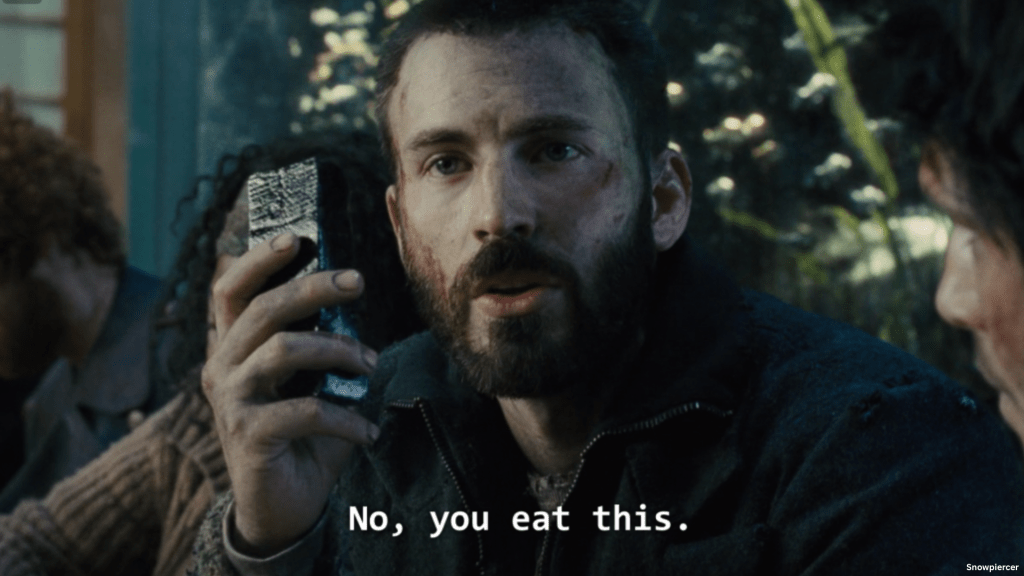
In Snowpiercer, those living at the end of the train, the “tail sectioners”, survive on protein bars made up of ground-up cockroaches. “The more difficult it is to identify what’s being eaten, the poorer you are. At the front of the train, the food is recognizable. At the back, it’s just survival” says Prof. Broodryk. The wealthy citizens at the front of the train enjoy luxurious multi-course meals with fresh ingredients all grown on the train.
Similarly in The Hunger Games, certain districts experience severe poverty and food scarcity, while residents of the Capitol indulge in extravagant feasts. Inside the arena, tributes must win the favor of spectators in order to receive food and medicine.
“Food can be nourishment, but it can also be humiliation. Those in power decide not just who eats – but how”, explains Prof. Broodryk. Nowhere is this more evident than in The Platform.
In the film, an elaborately prepared feast is placed on a platform that slowly descends throughout the levels of a vertical prison. Prisoners at the top eat first, while those further below are left with whatever scraps remain. As the food literally moves down the hierarchy, the system makes it quite visible how access to nourishment is shaped by power and position.
In many of these films, class inequality is felt viscerally because the food available is not just scarce, but deliberately presented in ways that evoke disgust. Contaminated, decaying, or barely recognizable meals emphasize the desperation of survival.
Cinema is a sensory medium, and food in particular invites viewers to imagine taste, smell, and texture. Because eating is such a universal experience, scenes that depict unappetizing or spoiled food helps understand the harsh realities that characters face.
At the same time, food also has the power to represent hope. In these films, revolutions emerge as oppressed groups fight the systems that control access to resources. Fresh, carefully prepared meals, which are often reserved for those who can afford it, symbolize the life that many characters aspire to. In this sense, food represents more than just nourishment, it offers safety, security and the promise of a better life.

Food as community and care
And while the strongest metaphor for food in post-apocalyptic films often evokes feelings of disgust, survival and inequality, films and series have also used food, and the act of sharing food, to portray community and caring, and the best of humanity.
Famously in the Last of Us, Bill carefully prepares meals for his partner, preserving a vision of a better life in the midst of a zombie apocalypse. In Station Eleven, meals are regularly shared between surviving travelers. Though these scenes are quiet and temporary, they create brief spaces of safety and connection within otherwise uncertain worlds. “The viewer knows these moments won’t last, but they make survival possible,” explains Prof. Broodryk.
These scenes are far and few between, but when they do appear they share an important function: they allow characters to stop being mere survivors and begin to feel like friends and families. The act of sharing a meal plays a central role in developing and maintaining relationships, and these scenes create a pause in the constant struggle for survival, reintroducing familiar social rituals.
Quite the opposite is shown in Wall-E, where the act of sharing a meal has all but disappeared. Humans consume food mechanically, entirely isolated from one another and we see how far society has drifted from these every day social rituals. What makes Wall-E interesting, is that the possibility of growing food (and a small robot), is ultimately the catalyst for returning to Earth.

Reflecting real-world anxieties
The enduring appeal of post-apocalyptic films is arguably rooted in our collective societal and environmental anxieties. As Prof. Broodryk explains, “the anxieties we see in post-apocalyptic films are the same ones we live with now: water, climate, access, unpredictability”.
These stories exaggerate fears that already shape our everyday lives, from climate and political instability to fragile food and water systems. Science fiction gives us free reign to safely imagine these worst case scenarios and explore their consequences without ever leaving the comfort of our homes.
Part of the appeal lies in the questions these films provoked, helping to clarify our own values and morals and inevitably wondering: what would I do in that situation? Zombies, nuclear fallout, and environmental collapse may still feel distant enough to remain fictional, but the experiences that surround them, like hunger, scarcity and the need for community are very familiar.
In particular, food becomes a powerful bridge between these imagined futures and our present reality. Everyone understands what it means to share a meal, to feel hungry, or to worry about access to food. When post-apocalyptic films show characters rationing supplies, scavenging for food, or gathering around the table to share a meal despite everything, these moments resonate with audiences on a deeper level.
Communal meals reinforces the value we place on relationships and care, while stark inequalities in food access force us to reflect on our own world – where healthy, diverse food is still unevenly distributed.
In this way, these films do more than depict collapse. They are also a reminder of hope, and a reminder that the simple act of eating together can strengthen communities. Even in the bleakest futures, these stories suggest that survival is not only about staying alive, but about maintaining that which makes life meaningful.
In the series Station Eleven, a traveling group of actors and musicians perform Shakespeare for scattered communities long after civilization has collapsed. Their motto, “survival is insufficient” captures this same idea that appears again and again in post-apocalyptic films, characters are not just searching for calories, there are searching for safety and community. As Prof. Broodryk puts it, “in a place of abundance, you don’t just survive – you live”.

And so what are characters eating anyways? It’s clear that food isn’t just food in post-apocalyptic films.
It’s power, privilege, and sometimes just pure survival. From the cockroach protein bars in Snowpiercer to the Capitol’s over-the-top feasts in The Hunger Games, what ends up on the plate reveals who is winning and who is just scraping by.
But it’s not all grim: a shared meal in The Last of Us reminds us that even in a zombie apocalypse, food can spark connection, hope, and humanity. These films exaggerate our collective anxieties of scarcity and collapse, but they also celebrate those familiar social rituals that make life worth living.
At the end of the day, the table isn’t just a place to survive, it’s a place to live. And maybe that’s the biggest lesson these post-apocalyptic films have to offer.

Morgane Bataki
Morgane is co-founder of The Foodscapes Collective and full-time PhD student in Environmental Sciences at the Open University of the Netherlands. She holds a BA in Cultural Studies and an MA in Food Politics. While her research focuses specifically on transformations towards sustainable agriculture, she is equally passionate about all things food-related, especially exploring the world through diverse cuisines.
Want more content like this? Subscribe to The Foodscapes Collective to be the first to know about articles like this and more.





 The Foodscapes Collective
Leave a comment