Tasty, diverse, and deeply symbolic, chillies (Capsicum spp.) have sustained and defined the Indigenous Maya diet in Mexico’s Yucatán Peninsula for generations. They are a cornerstone of the traditional milpa agricultural system developed thousands of years ago, where Maya farmers have long cultivated rainfed polyculture plots, interweaving corn, beans, squash, tomatoes, and chillies in a biodiverse landscape.
Complemented with other herbs and roots, these five crops provide all essential nutritional requirements, supplying calories, protein, vitamins, and minerals1. Within the milpa system, which includes agricultural fields, home gardens, and surrounding forests, farmer families cultivate and gather a remarkable diversity of plants, including 32 native plant species used for food2. Additionally, families maintain a diversity of domestic animals, as well as hunt a few species in the neighbouring forests3. Some authors report as many as 74 dishes and beverages derived from the milpa, with chilies featured in over nine of them4.
This culinary diversity is not merely a matter of quantity, but also of technique, tradition, and symbolism. Nowhere is that more evident than in relleno negro, one of Yucatán’s most distinctive dishes.
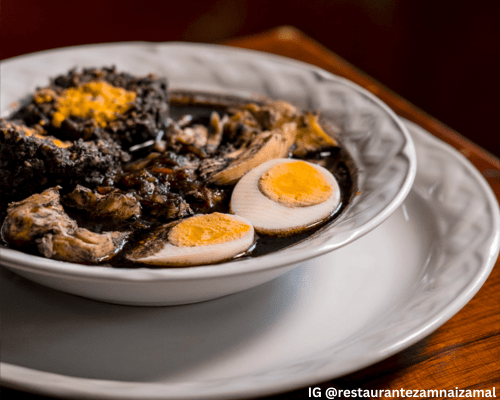
Traditionally prepared from scratch, relleno negro begins with an important step, burning a specific type of local chilies, called chawa iik in Mayan language, until they are completely charred. The process is completed by mixing the chilies with garlic and pepper, amongst others, to create a black paste (recado negro) – the deep, smoky foundation that gives the dish its name and character.
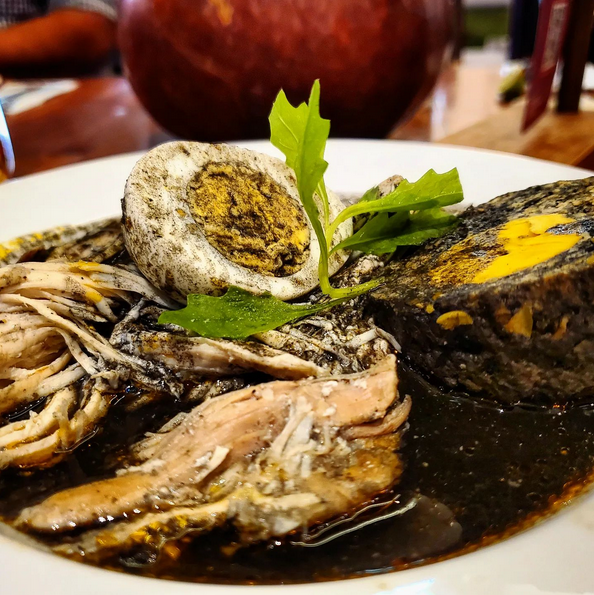
The final dish is prepared with native turkey, minced pork, and eggs, and has a rich soup-like consistency. It is served in plates or prepared in tacos and salbutes.
Tacos are freshly hand-made from corn tortillas from the milpa. The corn is cooked and steeped in water with a food-grade lime solution5, then drained, rinsed, and milled into a dough and cooked by hand.
Salbutes, a local delicacy, use the uncooked tortillas which are fried in oil, giving them a crispy texture. The relleno negro is then spread on top of the tacos or salbutes. These variations can be found in local markets and restaurants across the Peninsula.
While widely available, this dish holds great significance in the social and cultural life of the region. It is served at celebrations and important occasions, such as birthdays, weddings, and christenings across social and economic lines.
In my own family, it is my father’s preferred dish for his birthday. When I was growing up, my chichí (grandmother) prepared relleno negro for him every year. I have vivid childhood memories of the big pot simmering as plates, tacos and servings were passed around in our backyard.
As my dad’s birthday falls between Christmas and New Year’s, the dish has become an integral part of our end-of-year celebrations. Nowadays, especially in urban areas, many people don’t make relleno negro from scratch. Burning chillies is no small feat. Instead, we get the ready-made spicy or non-spicy paste from the local market and preserve it in the fridge.
Last year, as part of my work, I visited several rural Maya families in their home gardens. In one of them, I was shown a shrub laden with green chilies, the chawa iik, and was gifted a few, which were incredibly spicy! When the time is right, these chilies are destined to be charred and prepared for a celebratory relleno negro.
Relleno Negro Recipe6
For the paste (recado negro):
• 1 kg of dried chilies
• 1 Tabasco pepper (Pimenta dioica)
• ¼ teaspoon of cumin
• 1 tablespoon of Castilla peppers (black pepper – Piper nigrum)
• 1 ½ tablespoon of achiote paste (annatto seed paste)
• 1 garlic bulb
• 5 o 6 oregano leaves
The dried chilies are left without seeds and ends, and then they are burned with alcohol until charred. Following, they are soaked and washed with water, before mincing them with the other ingredients, until forming a paste.
For the relleno negro (15-20 persons):
- 1 turkey (7 kg) – clean and prepared
- 1 garlic bulb, grilled
- 1 onion, grilled
- 2 epazote stems (with leaves)
- Tabasco and Castilla peppers, minced (to taste)
- Cloves, cumin, cinnamon and oregano, minced (to taste)
- 2 bay leaves
- Salt (to taste)
- 200 gr of recado negro
- ½ tablespoon of achiote paste
- 8 tomatoes, quartered
- 4 tablespoons of flour (or corn dough), dissolved in water
For the stuffing (relleno or buut’ in Mayan language):
- 1 kg of minced pork
- 100 gr of recado negro
- 2 eggs, lightly beaten
- 2 tomatoes, chopped
- ½ onion, chopped
- 1 epazote stem (with leaves)
- Tabasco and Castilla peppers, minced (to taste)
- Cloves, cumin, cinnamon and oregano, minced (to taste)
- 1 tablespoon of corn dough
- Salt (to taste)
- 8 eggs, boiled (chopped whites and whole yolks)
Preparation (buut’):
- Dissolve the recado negro in the beaten eggs
- Mix well with the other ingredients, except the chopped eggs
- Incorporate the chopped egg whites into the minced meat
- Carefully add the whole yolks to this mixture and stuff the turkey with it
- Or, for an alternative non-stuffed turkey, form small balls with the mixture, placing a yolk in the centre
Preparation (soup): - Heat enough water with roasted garlic and onion, epazote, peppercorns, and the spice mix
- Add the stuffed turkey or turkey pieces with the prepared meatballs
- When it boils, remove a little broth to dissolve 200g of recado negro with the achiote paste
- Once dissolved, add it back to the pot and continue boiling
- Before the turkey is fully cooked, add the quartered tomatoes
- If the broth becomes too thin, add corn dough or flour dissolved in water to thicken it; it should be dark and thick
Preparing the plate: - If the turkey was stuffed, serve in a soup plate with some soup and some turkey with the stuffing
- If the turkey was not stuffed, serve in a soup plate with shredded turkey and a slice or two of the buut’
- If making tacos or salbutes, the turkey is shredded and thebuut’ sliced – this is spread on top of the tacos or salbutes with some of the thick soup on top
Footnotes:
- Ek Dzib, J., Hernández Baltazar, I. & Noriero Escalante, L. (2013). La milpa en Yucatán, desde una perspectiva del buen vivir. Veredas, Revista del Pensamiento Sociológico, 193-208. ↩︎
- Colunga-GarcíaMarín, P., Zizumbo-Villarreal, D. (2004). Domestication of plants in Maya Lowlands. Economic Botany, 58 (Suppl 1), S101–S110. https://doi.org/10.1663/0013-0001(2004)58[S101:DOPIML]2.0.CO;2 ↩︎
- Cabrera Pacheco, A. J. (2025). Traditions and territories of Maya women in the Peninsula of Yucatán, Gender, Place & Culture, 32(5), pp. 775–795. https://doi.org/10.1080/0966369X.2024.2443210 ↩︎
- Salazar, C., Zizumbo-Villarreal, D., Colunga-GarciaMarín, P., & Brush, S. (2016). Contemporary Maya food system in the lowlands of northern Yucatan. In: Lira, R., Casas, A., Blancas, J. (eds). Ethnobotany of Mexico: Interactions of People and Plants in Mesoamerica (pp. 133-150). New York, NY: Springer New York. https://doi.org/10.1007/978-1-4614-6669-7_6 ↩︎
- https://www.cimmyt.org/news/what-is-nixtamalization/ ↩︎
- Recipe compiled from Concepción Hernández, Cocina y Repostería Práctica, 3a edn (Imp. Oriente, 1950), ii; Will Rodríguez, El Pequeño Gran Libro de La Cocina Yucateca, 2a edn (Editorial Dante, 2017) and corroborated by my mother Julia Pacheco Ávila, based on her learnings of cooking with her chichí Julia. ↩︎

Ana J. Cabrera Pacheco
Ana Cabrera Pacheco is a human geographer with interests in feminist geographies and decolonial perspectives. Her research practice aims to understand the relationships between people and communities with the territories they inhabit, in particular Indigenous communities. She is currently working in the Agrobiodiversity Conservation and Management programme within the government of Yucatán in Mexico. Recently, she completed a Postdoctoral Research Associate position at the University of Edinburgh where she worked with Maya Indigenous communities in Guatemala on their lived experiences after a disaster. Particularly, she focused on the agrifood practices of Maya women in post-disaster resettlements developing, amongst others, a Tz’utujil recipe book with them. Previously, she worked with Yucatec Maya communities in Mexico, critically approaching questions of agrifood, land, livelihoods, and identities. Her work has been published in relevant journals, such as Gender, Place and Culture, and presented in international conferences, such as the Latin American Studies Association (LASA) Congress.
Want more content like this? Subscribe to The Foodscapes Collective to be the first to know about articles like this and more.



 The Foodscapes Collective
Leave a comment