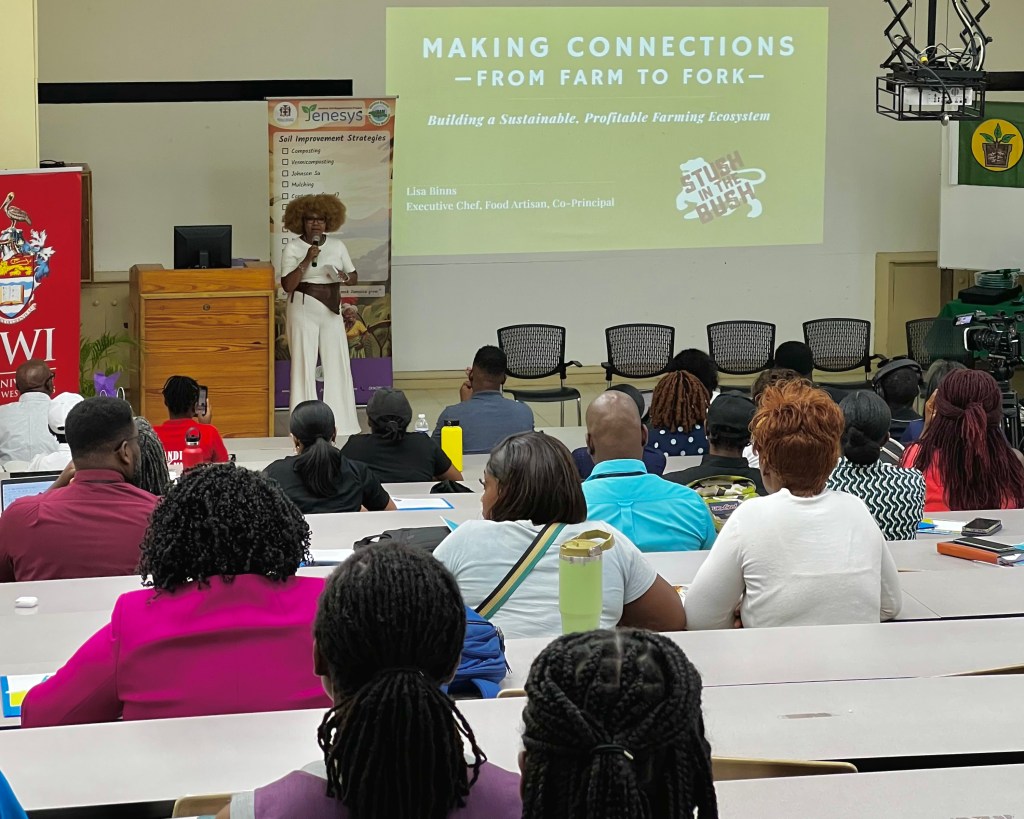
The third annual Farming as a Business Conference, hosted by the Jamaica Organic Agriculture Movement (JOAM), was held on Thursday, July 10, 2025. This was the first time that the conference was held at the University of the West Indies, Mona Campus.
The day-long gathering drew well over 120 participants, including government officials, organic vendors, farmers and academics. Scheduled to run from 8 a.m. to 6 p.m., the conference presented a dynamic program full of informative presentations, vibrant discussions, and local flavors.
The theme of “Making Connections From Farm to Fork” framed the day’s discussions on how organic farmers in Jamaica can navigate the entire food value chain. Topics ranged from production and processing to marketing and distribution.

Sessions addressed essential business skills such as crop costing and budgeting, business planning, niche markets, organic livestock profitability, and even the medicinal herb industry. A standout feature of the event was a seed swap, encouraging participants to exchange seeds, share knowledge, and build community.
“People don’t even know there’s an organic sector,” says Nicola Shirley-Phillips, Team Lead for the conference and Project Lead of Jenesys. “So by doing this, it allows all people interested in organic to see that you can actually do it as a business.”
She adds, “We should have this here because, especially for organic farmers, we don’t have any educational opportunities or conferences like this to bring people together.”
Phillips cited the inspiration for the conference came from the Appalachian Sustainable Agriculture Project in North Carolina.

The day began with opening remarks by Orville Palmer, Chief Technical Director, Technical Services Directorate, Ministry of Agriculture, Fisheries and Mining. The event was moderated by Althea McKenzie, host of Farm Talk on Power 106 FM.
The featured keynote speaker was Lisa Binns, a food artisan, executive chef, and co-principal of Stush in the Bush. Binns shared with The Foodscapes Collective about her philosophy of minimizing waste and maximizing creativity using what the farm provides:
“One of the most important things that a farmer can really do is take advantage of what it is that they have. We really try to utilize whatever it is that is coming in in abundance on the farm… Pumpkin can be a little bit more than just sip. It can be hummus, it can be ravioli… For us, it’s about using what you have… Growing food can be really sexy, especially if you are a person who really thinks about what you are going to do with that product at the end.”
Adding a flavorful centerpiece to the event, attendees were treated to a fully plant-based lunch catered by Stush in the Bush. Served family-style, the meal included pumpkin ravioli, pumpkin soup, banana chips with pumpkin hummus, fresh salad, and a decadent chocolate cake. The meal was complemented by lemongrass and ginger iced tea, as well as Stush in the Bush’s signature pepper sauce.

Outside the main conference auditorium in the Chemistry Department courtyard, the event featured a bustling plaza of vendors offering organic produce, value-added products, herbal remedies, and more. Many of these vendors can be found at the Ujima Saturday Market.
Zuberi, a partner in Irie Lyfe, farmer and honey product vendor, expressed appreciation for the opportunity, saying, “Today was great, there was a lot of information shared.”
Young entrepreneurs to seasoned farmers remained engaged throughout the day, with meaningful discussions and networking that extended into the evening. Although minor technical difficulties disrupted the Zoom broadcast, it didn’t dampen the in-person energy.
Allison Cummings of Busch Laiif brand, who has participated in the event since its inception, said, “It’s such a blessing and a feeling of gratitude to watch this conference grow from our first year until now.”

As Jamaica’s organic agriculture sector continues to develop, the Farming as a Business Conference stands out as a much-needed space for connection, education, and inspiration. With growing attendance and engagement each year, the event is helping to reshape perceptions of organic farming, not as a fringe or backyard activity, but as a viable, scalable, and sustainable business opportunity.
When asked about future plans, Shirley-Phillips laughed, saying, “I plan to rest. We’ll see what next year brings… but I think that this was good.”
She also praised the team of volunteers, saying, “To see that many people that came out and volunteered… I’m really grateful.”
Photos by Roshana G-mariam and Joel Matheson

Want more content like this? Subscribe to The Foodscapes Collective to be the first to know about articles like this and more.



 The Foodscapes Collective
Leave a comment