
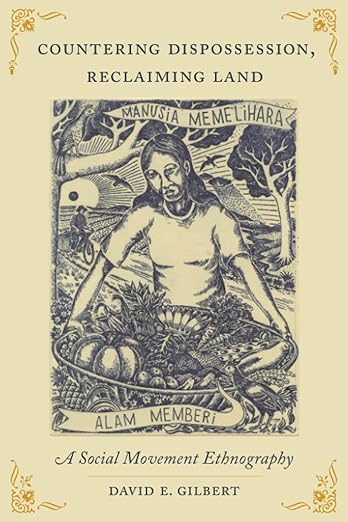
David E. Gilbert. Countering Dispossession, Reclaiming Land: A Social Movement Ethnography. University of California Press. 2024. $85.00 (hardcover), $29.95 (paper).
David E. Gilbert’s Countering Dispossession, Reclaiming Land presents a well-researched and insightful account of land reclamation in Casiavera, Indonesia. The book explores the story of a group of agricultural workers who, over two decades ago, began occupying an agribusiness plantation on their ancestral lands. Through sustained collective action, they reclaimed control of the land and transformed it from a monoculture plantation into a diverse agricultural forest. Gilbert’s ethnography offers an in-depth analysis of the ongoing movement, providing valuable insights into how communities can resist the forces of colonialism and capitalism while promoting more equitable and ecologically sustainable ways of living.
Gilbert begins the book by situating the events within Indonesia’s historical context. Starting the story after the Dutch forced coffee plantations in Indonesia for almost a century, the rise of Suharto’s New Order regime in the late 1960’s marked a shift away from smallholder farming towards large-scale, monoculture plantations. The governments lease to the Dona Company cattle ranch in 1968 further exacerbated environmental degradation and led to the exploitation of both land and labor.
One of the book’s key strengths is its detailed portrayal of how these workers mobilized against the plantation system, what Gilbert refers to as guerrilla gardening. Gilbert traces the roots of their movement back to the mid-1990s, when they began organizing around principles of collective land control and diversified livelihoods. Their direct action approach involved occupying the plantation land and gradually asserting control over it. Over time, they developed agroecological practices that restored the health of the land while providing for their families. By prioritizing ecological sustainability and community well-being, the movement rejected the exploitative practices of industrial agriculture.
Gilbert spent extensive time in Casiavera, conducting hundreds of hours of observation and interviewing a wide range of individuals. Supplemented with historical documents, maps, satellite photographs, oral histories, and personal photography, this mixed-methods approach offers a nuanced and comprehensive account of the movement’s history and its ongoing impact. His firsthand experience in the community lends credibility to his analysis and ensures that the voices of the reclaimers are central to the narrative.
A major theme in Countering Dispossession, Reclaiming Land is the unsustainable nature of colonial and capitalist dispossession. Gilbert argues that these systems, which prioritize profit over people and the environment, cannot expand indefinitely. This is a familiar story in the global history of land struggles, where indigenous communities and smallholder farmers have been displaced historically by colonial powers, but is still being played out through transnational agribusiness corporations. However, Gilbert offers a hopeful perspective by showing how the Casiavera movement has managed to resist these forces. Their experiences serve as an important reference point for ongoing discussions about decolonization, food sovereignty, and land rights.
The book also emphasizes the importance of solidarity among various social movements working towards decolonization, environmental justice, indigenous rights, and land reform. Gilbert contends that these movements must come together to challenge dispossession and explore new ways of living, even though the future remains uncertain. The experiences of the Casiavera reclaimers provide valuable lessons for these broader movements, demonstrating that it is possible to resist industrial agriculture and create sustainable, community-centered alternatives.
This is not without its shortcomings, as Gilbert points out some of the challenges that these community organizations have, sharing examples of how the council has enacted rules on the land which has been ignored by the smallholders like no planting of trees. But through quantitative and qualitative data he points out that the collective land serves the poorest population, providing those with access to land in order to be self sufficient.
The book discusses the financial challenges faced by smallholder farmers, including issues of indebtedness. Many farmers around the world are trapped in cycles of debt due to the costs of industrial agriculture, which often requires expensive inputs such as fertilizers, pesticides, and machinery. By rejecting these practices and embracing agroecology, many Casiavera reclaimers were able to break free from these financial pressures and build a more sustainable future. This focus on agroecology and financial independence is particularly relevant to current discussions about how smallholder farmers can resist the pressures of global capitalism.
This book review is ideal for everyday readers, scholars or students interested in social movements. the challenges of smallholder farming, agrarian studies, agroecology, or Southeast Asian history. While Countering Dispossession, Reclaiming Land can be read in its entirety for a comprehensive understanding of the Casiavera movement, individual chapters also work well as standalone readings for courses focused on decolonization, grassroots organizing, or agroecology and the role of local knowledge in sustainable agriculture.



 The Foodscapes Collective
Leave a comment