Controlled Environment Agriculture holds great promise for addressing global food security and sustainability challenges. By harnessing technological advancements and addressing barriers to accessibility, CEA can become a cornerstone of future food systems.
The United Nations Development Programme (UNDP) recently released an insightful article on Controlled Environment Agriculture (CEA) and its role in transforming food systems for sustainable development. Produced by the UNDP Singapore Global Centre with support from Singapore’s Ministry of Sustainability and the Environment, the report explores CEA systems, their social and environmental impacts, and the pathways for adoption in lower- and middle-income countries.
CEA encompasses a range of innovative farming methods that enable crops to grow outside their natural or preferred environments. Leveraging facilities such as greenhouses and vertical farms, combined with advanced technologies like AI, machine learning, and precision sensors, facilitates a controlled growing environment, allowing farmers to consistently monitor and manage growing conditions in real time.
The UNDP article emphasizes the benefits of CEA, particularly its potential to mitigate the adverse effects of climate change and weather variability. Another advantage to CEA is that it reduces water usage and chemical usage drastically and use less land to produce food.
However, it is not without challenges. Many current CEA systems are energy-intensive and costly to establish, which limits their accessibility and sustainability, especially in resource-constrained settings.
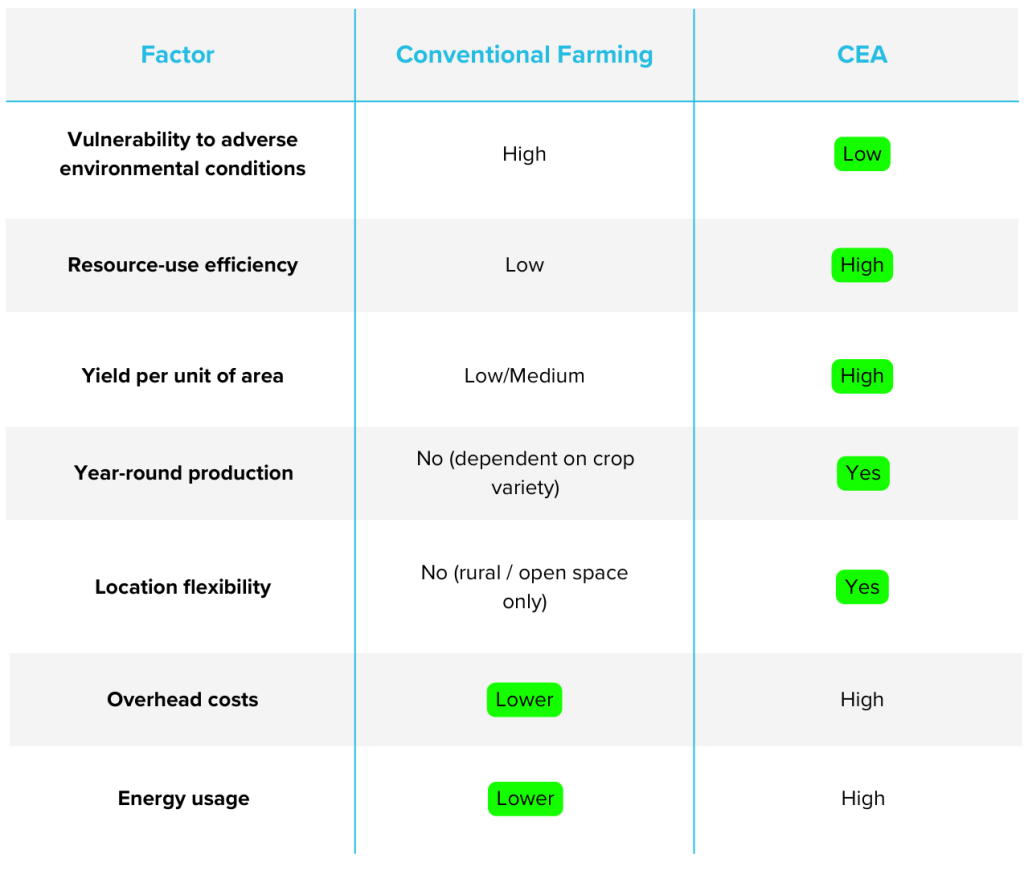
Due to its high energy dependency, significant initial investment, requirements for labor, technology, and equipment, CEA has a higher production costs per unit compared to traditional agriculture. The report suggests that integrating renewable energy sources could enhance the environmental sustainability of CEA, making it a more viable solution for the future.
In addition to detailing the technologies and challenges, the UNDP report provides real-world case studies and examples of organizations successfully implementing CEA (Indian startup Kheyti, Kenyan company Neruva Technologies, Australian startup LLEAF, and UK-based startup Intelligent Growth Solutions). It also outlines strategic pathways to promote the adoption of CEA in developing countries, highlighting the potential to foster resilient and sustainable food systems globally.
More Information: UNDP. (2025). Controlled Environment Agriculture for Sustainable Development. United Nations Development Programme. Retrieved from https://www.undp.org/policy-centre/singapore/publications/controlled-environment-agriculture-sustainable-development



 The Foodscapes Collective
Leave a comment